
How many C-words does it take for the BBFC to decide that a movie needs to be rated 18—for adults only? That was the question I asked myself under my nose when I sat down to watch One Last Deal and saw that dreaded red circle on the screen, which was followed by a single phrase: “very strong language.” In fact, I think this was a rapid judgment call because my mind immediately connected this news with the C-word and not the F-word. After all, One Last Deal is a British production—and Americans live in crippling fear of the C-word—and the F-word has been normalized so heavily that it would have taken considerable effort to earn the 18 rating on the back of it alone.
So, back to the question: how many C-words is it?
Somewhere between two and ten. That’s what I can surmise based on the movie I watched. I know I have seen a number of films where the BBFC noted an instance of the C-word as a “single use of very strong language” and the rating was always lower than 18. Also, the BBFC applies context and they would treat this word differently depending on whether it was used as a term of endearment (which happens as Brits and Aussies will testify) or aggressively deployed as a vulgar slur.
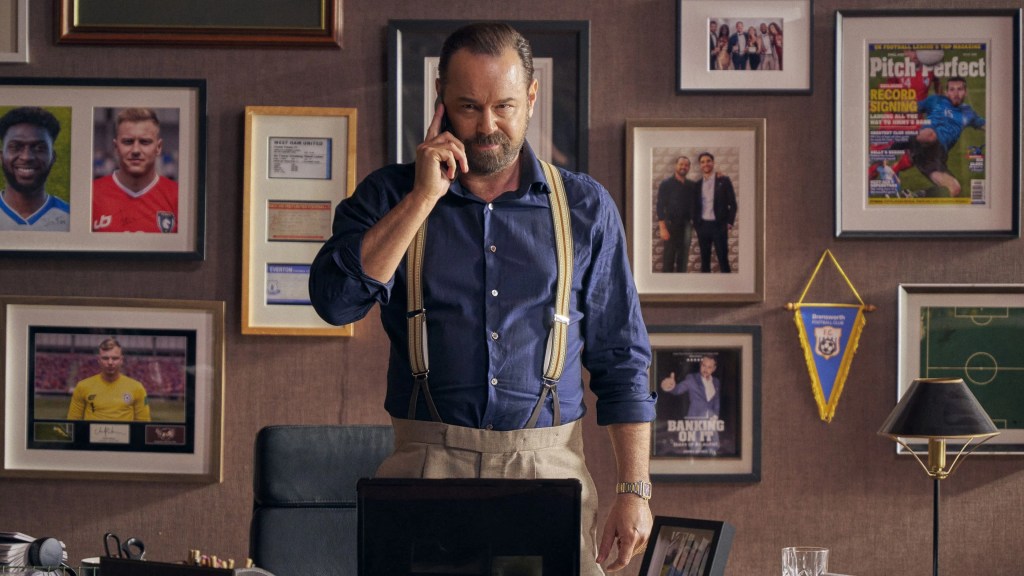
So, yes. Somewhere between two and ten aggressive C-words in the complete absence of anything else that would have weighed on the rating, like sex and violence. Because One Last Deal is a dialogue-driven one-man show. A single-location one man show, to be exact. And all those C-words are uttered by Danny Dyer.
Directed by Brendan Muldowney from a screenplay by Peter Howlett, One Last Deal resurrects the once-popular format of movies bound to a single confined location and driven by one key performance (with others frequently coming into view with the use of technology) like Buried or Locke and points the camera at Jimmy Banks (played by Dyer), a ruthless football agent, and stays with him for the duration of one entire day. And it just so happens that this day becomes quite special. As he awaits a jury verdict in a rape trial of a football player he represents, Jimmy is blackmailed by a mysterious person with access to information that could sway the verdict and must use his cunning to find a way out of this bind.
Consequently, the film sets itself up for nothing more than just under ninety minutes of tight, dialogue-driven thrills that infrequently brush against the kind of energy we would find in spades in movies like Uncut Gems, Daddy Longlegs or even Marty Supreme, only scaled down to fit within one room and engineered so that the story could take place using phone calls, messages and emails in addition to following the progressively degrading mental state of the central character who plays whack-a-mole with his problems. In fact, he creates brand new problems for himself while solving others and implicates other people in his dealings as he goes about it. And for the most part, the movie is rather entertaining to sit through. That is unless you are a Mormon and cannot stomach salty dialogue. Which is rather theatrically rough, I might add. In fact, if you were to remove all spicy language from this movie, I think you’d arrive at a running time that would rival a Calvin Klein commercial. But that’s neither here nor there.
What matters, though, is that One Last Deal almost—and this is key: almost—gets away with its own gimmick as it attaches the viewer to Jimmy Banks’s shoulder and takes them on a bit of a ride where the entire story is played out on Danny Dyer’s face while the plot unfolds using nothing more than phone calls and information delivered through various screens. In fact, in contrast to Locke or Buried, which take place in unorthodox locations, One Last Deal would have made a rather formidable one-act play and probably it would have registered much better in this scenario. And that’s because oftentimes narrative convenience is quite a bit more excusable when it’s deployed in a live stage performance; perhaps because in contrast to a movie, there are physical limits to what can be achieved there.
But this is still a movie. And as much as it keeps the viewer in a tight grip for most of its duration, the film eventually sours its relationship with the audience by defaulting to convenient solutions (that only look elegant in theory) and shamelessly ties a neat bow using all of its dangling plot threads, loose ends and seemingly throwaway side-stories. Because everything in this movie matters to the central story. There’s no colour or texture to anything we see. All elements—characters, information, dialogue, monologue… everything—are 100% functional. Therefore, there comes a point, structurally somewhere close to the theoretically calculated place for where the climax should be, where we can see in real time how the contract with the story crumbles like a stale croûton because the filmmakers want to make everything look tight and pretty and pitch-perfect so that the plot would dovetail into the themes and that all of the preceding struggle would transmogrify into a takehome message with a moral resonance. I almost saw the stars in my rating dissolving into nothingness like Marty McFly’s siblings in that photograph that reminded him of his mission to get his parents to fall in love in Back to the Future.
Thankfully, the movie wrapped before my overall rating could dip into negative review territory. All in all, One Last Deal registered as a mildly entertaining picture that runs on pure adrenaline for a good chunk of its running time before falling apart in spectacular fashion. I’d say it’s worth seeking out if these gimmick movies are your bag, or if you want to see the kind of range Danny Dyer is capable of when he’s asked to carry the movie solo.


 Flasz On Film
Leave a comment