
In a world where a significant percentage of new releases fit under the collective umbrella of “eat the rich” satires—turbocharged by the still relatively recent Best Picture victory of Bong Joon-ho’s Parasite—the idea of Park Chan-wook (Oldboy, The Handmaiden) also directing a movie in this space doesn’t really raise any eyebrows. But No Other Choice is a different beast entirely. And one that hit me personally much more profoundly than any of the more prominent examples in this subgenre in recent memory. And I wasn’t necessarily prepared for that.
Adapted from Donald Westlake’s 1997 novel The Ax, which was made into The Axe by Costa-Gavras to whom Park dedicated his take on Westlake’s material, No Other Choice is a movie that infuriated me while simultaneously dazzling my senses with its impeccable visual artistry. This, by the way, is both a compliment and an admission that I’m not exactly sure if I was in the wrong frame of mind to be watching this given my personal situation, or maybe it was exactly the kind of movie I needed to see to re-contextualize my own predicament somehow, because one way or another No Other Choice acted a little bit like a hyper-stylized fun-house mirror in which I saw my own warped reflection.
I have been formally out of work for almost eight months now. This is the longest period of continuous unemployment in my life and as of now, short of a miracle or a sudden twist of fate, the prospects of this situation changing in the coming months are slim. The industry I have worked in—I almost wrote “my industry” and then I stopped myself because at this point I don’t even know if it has ever been “mine” at all—has undergone a considerable contraction over the last couple years and last summer I found myself at the business end of a massive layoff. “It’s not personal” I told myself as I looked down the barrel of an uncertain future. “There’s just no other choice” I heard from senior management. The business needed to protect itself from the tides of the market and ensure its own survival. I was rendered surplus to requirement for company’s survival.
It is honestly impossible to articulate how surreal it is to walk into a room greeted by an HR rep and one of the senior leaders who then asks how you’ve been knowing perfectly well that he’s about to sack you. You can’t help but smile at the sight of that cliché box of tissues sitting slightly off-center on the table when you hear, as though through a thin wall, how the company values your contributions but that going forward your skills and expertise will be deemed superfluous. The people doing the firing will hide behind the business. It’s the only way. They’ve tried everything else and reduction in force is the only way out. They are only following orders. There. Is. No. Other. Choice.
Seeing this play out on a movie screen ignited some latent anxiety hiding deep within my consciousness. Catalyzed by Park Chan-wook’s masterful grasp of visual storytellling, I was thrust all the way back to what I thought I had already processed. It turns out I had only squirreled my emotions away. Typical man.
I spent weeks grieving, telling myself that my work was separate from my identity. That I’d bounce back. That surely someone would see my skills and experience as crucial to their mission. But it turns out that I might have been wrong. Life is just cruel that way, it seems. For every position there’s a few hundred people. Thoughts and prayers don’t translate to leads. When you’re reduced to a piece of paper that hiring managers spend on average eight seconds looking over, your sense of self-worth—already injured by the trauma of getting laid off—is only going to suffer further. And after a while it all does begin to feel incredibly personal.
The “it’s just business” defence behind which companies cower while shedding staff in pursuit of their own financial wellbeing, shareholder value or prolonged survival might not feel personal to those making those decisions—one death is a tragedy while a million is a statistic—but it sure feels personal when it’s you who’s shown the door. Even more so when after months of applying, networking and reaching out to all those Pokemon you’ve collected as your LinkedIn connections all you have are bruises from bashing against the seemingly impenetrable wall of rejection. Your skin eventually thickens and your grief calcifies into directionless frustration—the most dangerous of them all. When you feel radioactive, you emit deadly particles in all directions.
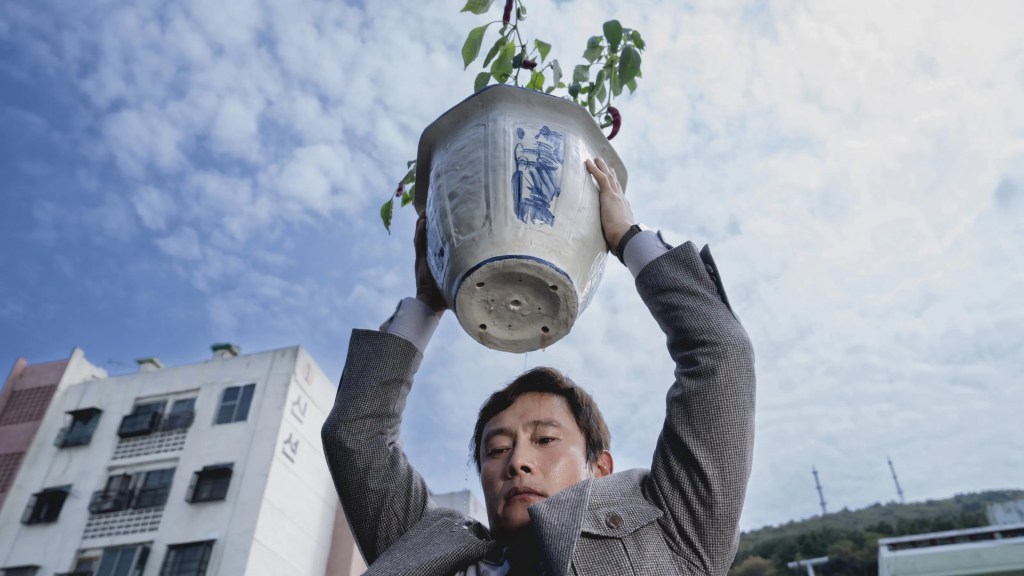
That poster shot from No Other Choice is a perfect encapsulation of a multitude of complex emotional states all poured into one character. A man whose entire identity has been taken away from him. His life purpose is gone. His sense of usefulness to his family completely undermined. It’s one thing to tell yourself that you’re enough and that your family values you for just being there but it’s equally incredibly difficult to overcome centuries of cultural programming that tells you otherwise. That as a man you are worth only what you bring to the table. And when someone takes away your ability to provide value, going into a tailspin is expected. You will blame yourself. You will rationalize. You will excuse and justify the decision that put you and your family in peril.
I thought I had avoided blaming others. I thought I was taking the high road by telling myself and those who asked that I understood this decision. I didn’t like it but I understood it. That’s true. But it’s also not the whole truth. By defaulting to this answer I managed to completely circumnavigate the notion of telling anyone how I felt and lied by omission. And only recently I came to terms with the extent of regret and anger I have been carrying deep inside.
Looking at a grown man standing on the roof of a building and holding a potted plant over his head, ready to fling it at someone else in a flurry of murderous rage, I felt kinship with him. What’s more, I felt that the filmmaker had spent enough time conceptualizing this convoluted emotional turmoil that would engulf a man who was placed on the edge of sanity and given a gentle push off the cliff. And although the movie directs the narrative towards a wish fulfillment fantasy, it sure felt emotionally realistic enough and hence chilling to the bone. Because I saw myself with that potted plant. I projected my angst at that movie in which a man—out of sheer despair and helpless rage—directed his frustration not at those who hurt him, but at others just like him. At other men who were also surplus to requirement, also looking for a landing zone, also adrift and devoid of purpose. It was as though someone showed me a dramatization of my own mental state that forced me to justify the harm that was done to me. Man-su directed it outward while the vector of my frustration pointed inward instead.
By showing me Man-su’s desperate struggle devolving into a homicidal rampage—some of which is exquisitely hilarious in its own weird Park Chan-wook way—the movie helped me remember that it had been my choice, even if subconsciously driven by a sense of subservience to my employer, to place those responsible for upending my entire life in a company-sized blind spot. The movie opts for a cautionary fantasy to deliver its message that by using perfidious euphemisms like “it can’t be helped” or “there’s just no other way” businesses effectively manipulate the people they harm and subtly redirect their ire away from them. By concocting a plan to eliminate all of his competitors for jobs, Man-su behaved like a good useful idiot. He acted out in visual terms the idea of understanding that this was needed because the company is more important than the people who build it, run it and work in its service. He acted in defence of the status quo where the rich and powerful hold enormous sway over the lives and livelihoods of those they employ.
This is where I felt the full force of my own deeply hidden anger. I lived vicariously for those two hours through Man-su while hoping he’d see the light and redirect his energy towards those who deserved his vengeful wrath the most. No such luck. But the sole idea of sitting there in a puddle of my own extreme emotional responses to this story was enough to understand how I felt and to let myself off the hook. No—it was not my fault. Yes—there probably were other choices. In fact, there had been numerous opportunities to avert this disaster months before when nobody upstairs listened or understood that what they had asked of us was frankly undeliverable. But preserving the fallacy of perpetual growth and delivering short-term value for shareholders always comes first.
I saw Man-su as he failed to grasp this reality—that it was not his fault and that life was simply inherently unfair and unjust—and found a shard of inner peace. I saw that despite what he thought about his own value—that he was only as good as the food he brought to the table—his wife was always with him. Through thick and thin. I too am not alone in this and I frequently forget it or downright fail to acknowledge it at all.
That’s how No Other Choice ended up a thoroughly discombobulating experience. A roller coaster of emotions that’s probably uniquely accessible to me and those who have gone through what I have experienced, and nobody else. I was unsettled. I was disturbed. And I emerged serene. Somehow at peace. I shamelessly used this beautifully engineered movie as a punching bag or a pillow into which I screamed at full blast. I imagined myself standing there with that potted plant and understood what I had been running from—acknowledgment that I had the right to feel angry and betrayed. And that I don’t owe anything to anyone. I felt profoundly at peace with myself when I understood that my profession does not define me as a person and my identity is not tied to my employment. It’s tied to the people I share my life with.
So, I don’t know how my life will unfold. I found that Man-su’s idea of a happy ending would taste sour in my mouth. But maybe that’s the point the movie was trying to make in the first place. To make me realize that getting right back into the rat race would not necessarily look like a victory. I’d still be a rat. There’s no telling where I’ll be six months from now. Maybe I’ll find a way out of this vortex of uncertainty on my own. Maybe I’ll find my way back to formal employment and join Man-su in his bittersweet existence. But at least I will be doing so with eyes wide open.

 Flasz On Film
Leave a comment