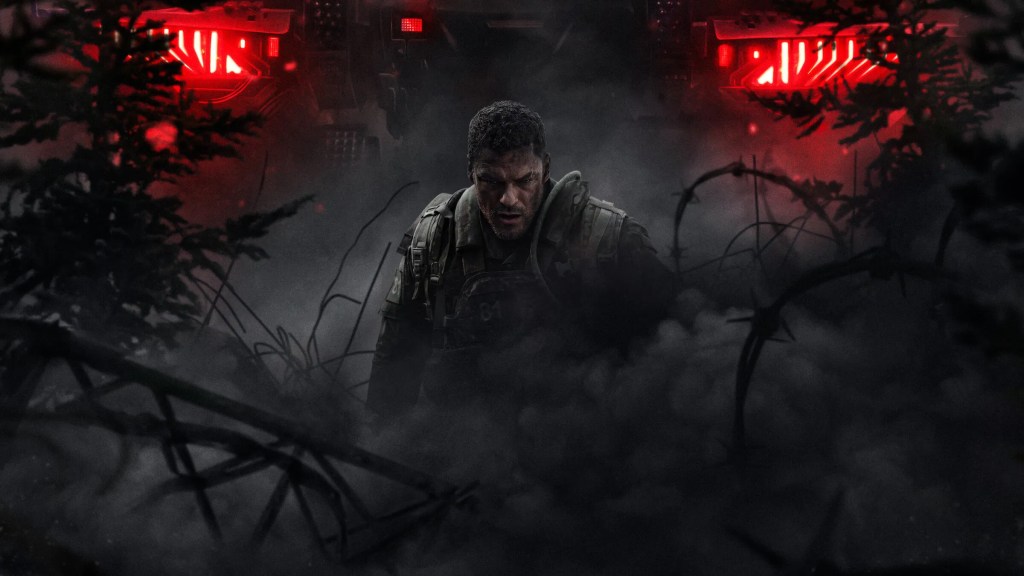

The circular definition of a “dad movie” states that it is a movie enjoyed by dads, i.e. middle-aged men with responsibilities, jobs and families in tow. And what do dads enjoy? Well—many things but the bulge of the statistical bell curve describing them would likely contain certain modes of escapist archetypes. Action. Explosions. War. Competence porn. One against many. Stoic machismo. Wish fulfillment. Getting stuff done. Rising to the occasion. Stepping up to the plate. Saving the day. Protecting the vulnerable. Guns. Guns. Guns.
And what if we expanded on all those archetypes and ideas, catalogued them nicely, supplied numerous relevant examples for each subcategory and then took all this ample data and fed it into a nice and shiny LLM before asking it to generate a piece of dad-centric entertainment that is likely to appeal to as many middle-aged men as possible under a certain budget and while obeying specific rules of engagement specific for Netflix-first productions? War Machine is the result of this experiment.
Directed by Patrick Hughes and starring His Hulkiness Alan Ritchson, Dennis Quaid, Stephan James and Jai Courtney for half a minute (which certainly wasn’t enough to convince him to shed the chub he had proudly displayed in Dangerous Animals), this movie is a big bowl of déjà vu that looks as though it was purposefully assembled to trigger some lizard brain neuron pathway present in all middle-aged dads and bring back fond memories of movies they used to like. In simplest terms, it is a story about a guy (Ritchson) who signs up to a US Army Ranger training program in the wake of his brother’s death (Courtney). After surviving the grueling boot camp that involved various physical aptitude and endurance challenges, he is sent onto a final assignment with a group of remaining candidates where they have to survive in a forest, accomplish a bunch of objectives and head back to base without being spotted or captured. However, instead of fighting against the elements and mock-up fireworks prepared by their grizzled Ranger boss (Quaid), the team end up facing a seemingly indestructible killer robot from space that has landed on Earth in their vicinity. That’s the movie in a nutshell.
And if your first thought is “hey, I recognize this plot structure from somewhere,” you are not wrong because War Machine is essentially Predator but with a robot instead of alien. Well, with the added boot camp first act which also seems to have been taken straight out of Starship Troopers or G.I. Jane. And you also wouldn’t be off the mark if you noticed that a bunch of the film’s action sequences—together with the forest setting—smell profoundly of Pete Berg’s Lone Survivor. So, in effect you might want to call this movie Lone Survivor but with an alien robot instead of the Taliban. Which also makes you think that Lone Survivor—strictly logically speaking—is essentially a play on Predator with the Taliban. And that robot angle itself looks inspired, both visually and in terms of execution of action set pieces, by the works Michael Bay and even—with some squinting—by another underrated gem directed by Pete Berg, Battleship.
However, the big problem is that while War Machine openly capitalizes on those tropes picked up from dad movie classics, it honestly doesn’t add anything of note to the mix. It is mostly a concoction of visual ideas and concepts magpied with clear intent to just be noticed and absolutely nothing more. The movie is otherwise rather bland and dramatically flaccid despite the fact that its central dramatic core should in theory work like a charm. The fundamental story underpinning all this—Ritchson’s character working through PTSD and unresolved guilt over letting his brother die who then has to snap out of it and lead his comrades to safety and defeat the seemingly unkillable threat by tapping into skills he forgot he had—is an archetypal underdog staple; a II-V-I chord progression in a minor key that’s eventually transposed to its major variant in order to get the audience to get off their sofas and cheer. Stories like this are “doomed to succeed” because they tap into some primal dad frequencies that tether the viewer and the character emotionally so profoundly that the alternative of cynically watching the movie with your arms crossed is simply impossible.
And yet, War Machine shows that it is after all a possibility, not because these dramatic chords are flubbed but because they’re played with zero flair. And the numerous extensions surrounding them for stylistic reasons occasionally drown out their dramatic progression.
Thus, it is a movie that feels and looks fake. It’s there to look like something you’d love but delivers very little to convince you that what it wants to sell you is worth buying. While anyone versed in their James Camerons and Michael Bays can easily swallow cliché-laden screenwriting, it’s hard to extend an olive branch to forgettable action sequences, immaterial deaths and anti-climactic conflict resolution.
Consequently, War Machine is a movie you will put on thinking that it might be something you’d enjoy because of those familiar neural pathways being activated, but soon enough you’ll find yourself wishing you were watching Predator, Starship Troopers, Lone Survivor or even Battleship instead. It’s less a dad movie than a piece of dad content recursively assembled to imitate something worth watching and delivering only mild blips of adrenaline and entire heaps of disappointment. In other words, it is Battle: Los Angeles of this decade. And Patrick Hughes instead of looking like a potential successor of that Berg-Cameron-Bay energy looks more like Jonathan Liebesman or Louis Leterrier.



 Flasz On Film
Leave a comment