
If I got a penny every time I sat down to write a thousand words about movies made by people who have moved across from a different discipline to try their hand at filmmaking, I’d have… probably, like, three or four pennies right now. Maybe five. Objectively speaking. But it sure feels like I’ve been thinking and writing about this concept and its many associated phenomena a lot recently.
We’ve seen Is This Thing On? by Bradley Cooper, who has accomplished one of the most successful recent transitions from just acting to acting and directing and then, a few months back, the world was finally allowed to witness Shelby Oaks, an indie horror film directed by a critic/YouTuber-turned-filmmaker Chris Stuckmann. And now that Iron Lung is out and about—an adaptation of an indie video game written, directed, edited and produced by Mark Fischbach, a YouTube phenom also known by his moniker, Markiplier—it surely looks as though I was about to plop down another kiloword on the page where I’d effectively have to revisit what I feel is a well-combed patch of cultural real estate related to famous people deciding to make movies, trial-end-error in the limelight, and all that jazz.
Which is what I am about to do, actually. And that’s because if I had to talk about the movie itself, the two hundred words I’ve already spent getting to this point would be incredibly excessive.
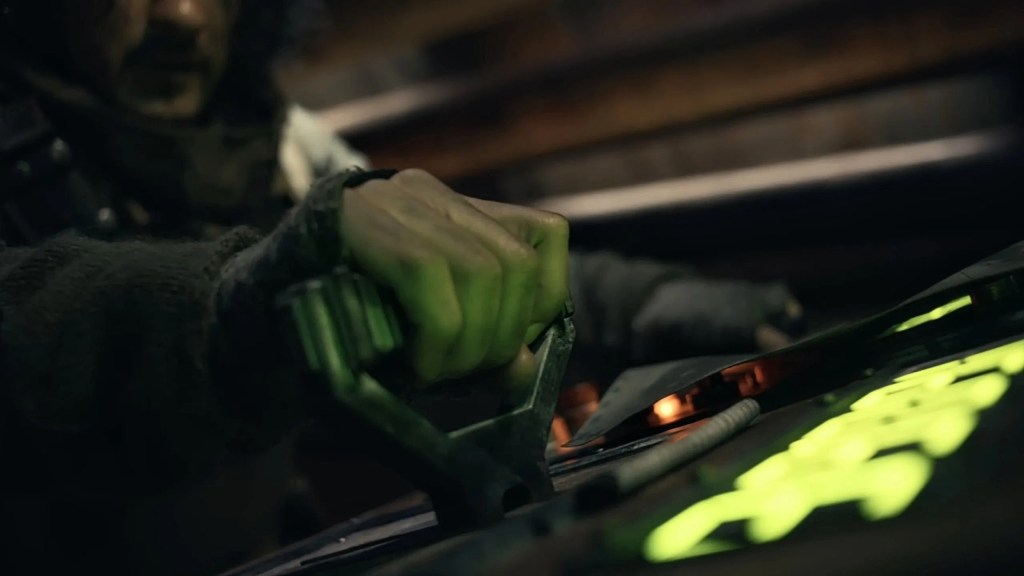
The story goes that Fischbach, who happens to have amassed incredible following on YouTube and whose personal platform rivals but a few others out there, had thought for a while about adapting Iron Lung—a conceptually sparse indie horror video game he had been a fan of, where the objective is to navigate a submarine using limited control abilities and vision through labyrinthine maps submerged in blood—into what he saw as a potentially moody and atmospheric hybrid of science-fiction and horror underpinned by the innate claustrophobia of its setup. After all, as the game essentially is a single-location experience, the movie mirrors this sentiment and sees Fischbach—who gave himself the lead role in addition to all other major production credits—turn knobs and dials while navigating a world that we essentially never get to see for obvious reasons, while he also slowly loses his mind. It is my strong belief that what drew Fischbach to this project was the mood itself, maybe combined with the edginess brought to the table by what I can only see as inspirations plucked from H.P. Lovecraft and the iconography owing a lot to Zdzislaw Beksinski and Hieronymus Bosch. Thus, what follows is the most charitable reading of what I can imagine the filmmaker was trying to achieve: a movie that looks like a spiritual successor to the vastly underrated cult classic directed by Paul W.S. Anderson, Event Horizon.
That’s what I think the mission was. What came out, though… well, this is where my ability to keep it civilized and retain some decorum is going to be put to a test because Iron Lung is not a very good movie. In fact, it is nearly unwatchable in places. At the same time, I remain fully aware of who made it, what their credentials are and thus I’m inclined to extend an olive branch and invite Mark Fischbach to respectfully sit down, take his medicine and maybe jot down some notes as we go, if that’s OK.
There’s just some fundamental science of making movies, which is a good idea to internalize. And something tells me that Fischbach—and I have no other recourse but to single the man out here, because in the style of Vincent Gallo and others like him, he was the one in full creative control of the movie that was being developed—didn’t quite know what he was doing. And it’s fine not to know these things. Most first-time indie filmmakers figure this stuff out by trial and error, or by way of feeling their way around the subject; much like what you’d have to do if you were locked in an unfamiliar location and someone turned off all the lights. But because the guy was essentially putting an amateur movie together in public thanks to his massive following, we get to survey the wreckage that is Iron Lung by means of public inquiry as opposed to a one-to-one performance review behind closed doors.
Right, so in order to put together a movie of any kind, you have a bunch of elements to think about. In fact, think of them much like those knobs and dials the guy in the movie turns. Each one of them does something different, some of them are related to each other, and they all help whoever’s in charge to navigate the movie like that submarine and get everyone to safety. Among others you have: tone, atmosphere (and these two are often related so when you play with one, you mess with the other as well), story, plot (and these are not the same, so be careful), characters, and a big ol’ console labeled as “craft” that hides everything from direction and performance to special effects, production design and music. And there’s also a little stopcock behind a break-glass door that manipulates the subtext. Depending on how you mess with them, you might be able to use your movie like a spectacle projectile, or navigate it pensively through a character-driven story, or precisely calculate the best trajectory to zip through the plot, or even do so in the most spectacularly bombastic fashion. The world is your oyster.
But the thing is that you must do something. You don’t have to use every tool available to you, but it’s a good idea to use most of them. A great plot is not required to make a good movie. Sophisticated world-building is also not a requirement. Hell, you can make a movie using cardboard, scotch tape and a hail Mary while hiring your childhood friends with absolutely minimal acting acumen and you can still produce a film worth watching, provided that the tone, subtext, story and ambition are somehow present.
Problem is that Iron Lung looks like a movie where not very many of these knobs and dials were in use after all. Sure, the ambition is there because Fischbach burned three million dollars (of what I believe must have mostly been his own money) and ended up breaking some kind of a world record in the biggest amount of fake blood ever used in production of a movie. Other than that, though? The tone and atmosphere are on point as the movie is appropriately brooding and visually suggestive. Production design is nice insofar as this was a single-location film and the scope of the job included just about a single costume and four walls. But that’s it. There is absolutely nothing else in this movie worthy of note. Bupkis. Nada. Zilch. Diddly-squat. Zippola. Sweet F-A. A grand total of not a whole lot. You get the gist.
Consequently, the experience of watching Iron Lung gets old immediately after the first twenty minutes as we get used to the aesthetic and the limited manouverability of the story. Fischbach gets angry. Fischbach navigates ship. Fischbach hallucinates. Fischbach over-emotes. Rinse. Repeat. That’s the movie. And there’s about two hours of this in here. Two whole hours! On what planet was it ever a good idea to stretch such a limited gimmick into one hundred and twenty-five minutes? Where I come from, the phenomenon observed in Iron Lung is referred to as acute and terminal self-indulgence. This is what happens when a single person takes charge of literally everything regarding the development of the film and nobody gets to tell them that not all of their ideas are bangers and—crucially—that it is not a requirement to use all the footage obtained during the shoot.
In all honesty, Iron Lung would have probably made a half-decent short capped at just under twenty-five minutes. We’d be able to savour the production design, immerse in the tone and condense some of the scary elements spattered about the running time. It would have played at Fantasia or some other festival and then premiered on YouTube where it would have become a viral sensation. Maybe it would have led to Fischbach being approached by someone in Hollywood to work on a bigger project, or he’d have learned the ropes well enough to actually make a feature that has enough legs to validate the need for the viewer to sit tight for two whole hours. But once again, because the guy is who he is, he doesn’t get the luxury of failing in complete absence of scrutiny. We get to see it. And because we had to sit through it, now we get to say what we think. And at least what I think ain’t pretty.
I suppose this movie and the entire experiment surrounding its production is a testament to something that we’ve seen a number of times in recent years across the cultural spectrum. Just because you’re great at something doesn’t mean you will be automatically great at something else, let alone everything. You can see this myth perpetuated in the productivity guru world and at the highest echelons of the tech industry. Remember how Elon Musk bought Twitter and thought he could make it better? Why not? He runs a number of companies and sends rockets into space. How hard can it be to run a social media company? Well, it’s not that easy. Sure, there are some transferable elements that can help you get better at something new—like discipline, drive, single focus and delayed gratification—but it doesn’t mean that you’ll knock it out of the park on your first swing. It’s just statistically unlikely. And Iron Lung should be that lesson. The movie is terrible, indulgent, overly long and extremely repetitive and the only value I could extract out of it is that it’s a great illustration of what happens when a filmmaker has no idea that darlings ought to be killed.
Funnily enough, I’m not so sure that the filmmaker in question is about to learn that lesson. Iron Lung has made enough money for Fischbach to go on a victory lap and remind everyone that nobody wanted to touch this project—and those who saw the movie should know why that must have been the case—and that the word of mouth was enough for this movie to sail into the sunlit uplands of financial success. There are few things more terrifying than someone who was accidentally proven right and something tells me that the guy who put this film together is now convinced that he knows how to make great movies. Which is false. He made a terrible movie that was cheap enough to make its money back because he already had enough of a following to make sure that if only a fraction of his fans went out to see it, he’d be financially OK. Now he is probably thinking about making another one and this is where an even more terrifying thought creeps into the picture. If someone is accidentally proven right twice in a row, they will become convinced that they have cracked the code and that they are the next Orson Welles or something.
Look, I’m happy that enough people went to see this film to make sure the guy got to make back the money he had burned and that he could pay everyone involved. I’m super happy that he was able to self-distribute an indie film and have it seen internationally. This is something even John Cassavetes couldn’t pull off on many occasions and not without re-mortgaging his house for the eighth time. But I detested the experience of watching Iron Lung. It was a turd sandwich without bread and watching it was a prolonged tantric torture. It should have been a YouTube short. And I’d like Mark Fischbach to make sure he doesn’t make the same mistakes again, but I have a sneaking suspicion that it might be too late for that and he might be about to join the club of those convinced that being great at something means you are great at everything.




 Flasz On Film
Leave a comment