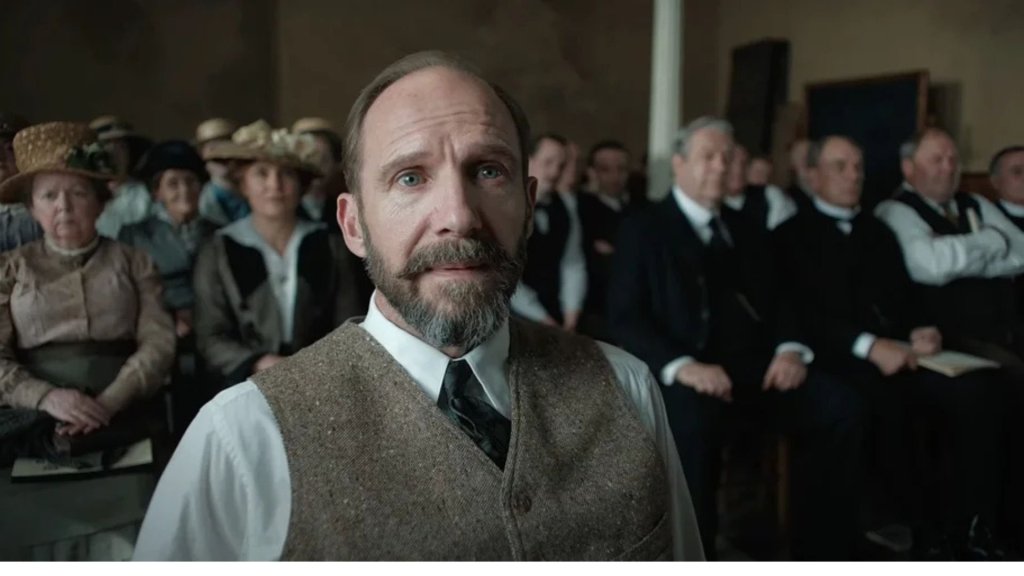

Synopsis: A small-town Yorkshire choir enlists the unconventional Dr. Henry Guthrie (Ralph Fiennes) to lead them through a wartime performance of The Dream of Gerontius, stirring tensions over faith, patriotism, sexuality, and artistic purity. As personal loyalties and romantic entanglements collide with the pressures of conscription and loss, the group’s determined staging becomes an act of quiet defiance.
The Choral is directed by Nicholas Hytner in his fourth feature collaboration with playwright Alan Bennett following The Madness of King George, The History Boys, and The Lady in the Van, not to mention numerous stage productions of Bennett’s plays. These two have been working together hand in glove for over three decades and it clearly shows that their artistic relationship is built on understanding the tricky interplay between stage and the screen and turning stories written according to the logic governing live performances, from scene blocking and detailed direction given to background players to engineering beats theatre audiences are likely to resonate with most profoundly, into narratives theoretically fit for cinematic treatment. This newest project of theirs, which also happens to be their first story written for the screen and not an adaptation of a stage play, is no different. Quaint, risk-averse and wholly manufactured, this is a product concocted in an artistic ivory tower and intended to stimulate the kinds of audiences that otherwise would not be out of place watching a Hytner production of one of Bennett’s plays on stage. It is the kind of movie most likely to be enjoyed by people who wear scarves in the summer unironically and choose to drink prosecco with their Sunday brunch.
In fairness, if it hadn’t been for a small handful of performances, specifically from Ralph Fiennes and Roger Allam, what The Choral has on offer would have come across as almost offensively tone-deaf, a story manufactured from whole cloth to become a broad church of mildly progressive themes packaged into a narrative box that doesn’t have sufficient structural integrity to hold all of them without falling apart, or to afford enough real estate to each of them to ensure they’d be explored on the screen to a satisfying extent. Thus, the movie can do nothing more than just glide over each of them in what looks like a progressive box-ticking exercise rather than an earnest exploration of either of them. And just focusing on one of them would have been enough to furnish a movie with a meaningful dramatic core and enough headspace to give its central theme some much-needed texture and depth.
I could imagine a world in which the story focused more on Guthrie’s complex personal life as a tragic social outcast who could not find kinship in his home country and who found love and understanding at a place considered to be a mortal enemy during World War I. We could have delved more deeply into the inner drama concerning the simple fact that Guthrie needed to conceal his true identity from everyone around him, as homosexuality—as alluded to in the script but not explicitly stated—was a criminal offence in Britain at the time.
We could have equally seen the movie lean into what looks like a mild anti-war stance where the quiet small-town life is disrupted by invisible forces of war and where the fabric of the community is torn and pulled apart by the political will of people we never get to see or hear from. There’s a conversation to be had about what happens to this fictitious Yorkshire town when its young men are at first coaxed to leave for war to prove their salt and eventually conscripted against their better judgment and shipped away to have the best years of their lives taken from them in the end. In fact, this is probably where the filmmakers expend the most energy. It’s in the tribulations of putting together a show for townspeople without male voices available; it’s in the choice to enlist surviving veterans scarred and mauled by their battlefield experiences; it’s in the tension concerning the choice of the piece to perform; in the urgency for these youngsters to lose virginity, as though quietly knowing that they might not go back home to find girlfriends or wives at all.
Finally, The Choral had ample opportunity to discuss the fraught dynamic between source material, its author and the artistic vision of those who choose to sculpt in the work of others while crafting a vision of their own. In a way, this is a piece of meta-commentary on what playwrights, directors and screenwriters often identify as an artistic tug-of-war between fundamental respect towards the work of others and the freedom to manipulate their work to beget new art.
Astoundingly, the movie chose not to make a choice at all and instead it tried to do it all. Consequently, because its resources and attention are finite, the product is less a set of diverse specialized tools all belonging together in a slick-looking packaging of competent cinematography and staging, and more a Swiss army knife—a pocket-sized multi-tool that is good to use in a pinch but utterly terrible at any and all jobs its constituent parts are theoretically designed to do. In fact, what this multi-tool also known as The Choral is good for is instigating a handful of disparate dinner conversations that will be as shallow as a puddle after an afternoon drizzle. But what they will achieve is a fleeting feeling of having something to say on a variety of subjects, if only to have something to talk about while consuming avocado on toast and chasing it down with that overpriced prosecco.
The Choral is nothing but a feel-good cinematic experience with very little artistic gravitas. It’s a tasting menu of disparate themes manufactured to resonate with a very specific demographic of viewers. Like Conclave last year and Summerland a few years before, it is nothing but “catnip for boomers,” a movie that looks as though it had something profound to say but it made sure it wouldn’t rock the boat at all while doing so. And that’s precisely because the stuff it seems to want to talk about is something the filmmakers are either not interested in exploring in detail, or simply not equipped to do so at all.
What this movie wants us to do is to look at the tragedy of closeted homosexuality, the fraught tension between artists and the destructive force of warfare exerted well beyond the frontlines, but do so through a window. The Choral is a piece of manufactured entertainment that looks as though it had a lot to say about lots of things, but the extent of originality and depth of thought going into every single aspect of its storytelling makes bumper sticker quotes look Confucian in comparison.


 Flasz On Film
Leave a comment