The Miloš Forman-directed One Flew Over the Cuckoo’s Nest celebrates this year the 50th anniversary of its release, and rightly so because it stands as one of the truly iconic movies of its era that both tapped into the social mores of its time and carved its name into the history of the film industry. It became the second movie ever to bag the so-called Big Five at the Oscars (Best Picture, Best Director, Best Actor, Best Actress and Best Screenplay) and only over forty years after Frank Capra’s It Happened One Night achieved this feat. The only other movie to have done this since remains Jonathan Demme’s The Silence of the Lambs.
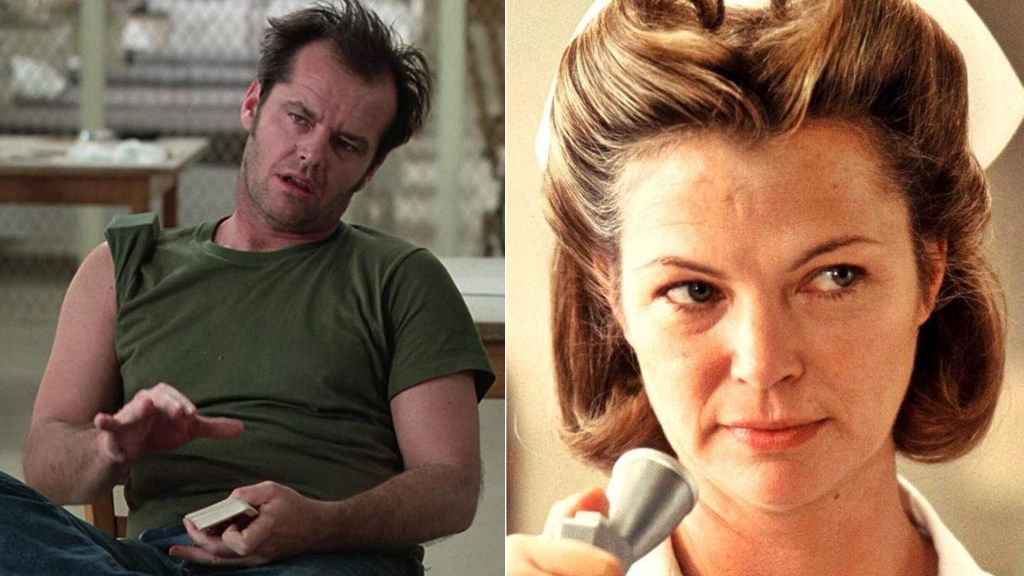
Additionally, and this is why I’m here today tapping profusely, this wildly popular adaptation of Ken Kesey’s brilliant novel entered the cultural lexicon with its many iconic scenes and unforgettable characters, like the Chief played by Will Sampson, Randle McMurphy played by Jack Nicholson and Nurse Ratched played by Louise Fletcher. In fact, it is a matter of public record that the two central characters of both the novel and the film—though I’d argue their iconic status owes more to the film than to the book thanks to the simple fact that movies had been the centre of the cultural conversation at the time—remain widely recognized and nigh-on symbolic.
McMurphy has been consistently described as a personification of the human yearning for freedom and defiance to authority as his free-spirited energy infected the ward into which he was confined and, while bringing about chaos and widespread disruption, illuminated to other patients at the hospital that they could stand up to cruelty, think for themselves and break the shackles of oppression. While his freewheeling stature probably wasn’t powerful or lovable enough to stand toe to toe with Big Lebowski’s The Dude, Paul Newman’s titular character of Cool Hand Luke, Bender from The Breakfast Club or Captain Jack Sparrow of the Pirates of the Caribbean series, McMurphy did indeed find himself on at least one list of great on-screen heroes.
On the other hand, Nurse Ratched immediately earned herself a permanent spot among the most recognizable and iconic cinematic villains. Fletcher’s performance as the cold, calculated and ruthless Big Nurse (as Kesey described her in the book) is going to be forever mentioned in the same breath with such iconic villains as Hannibal Lecter, Norman Bates and Darth Vader. And here I am asking myself if there is an opportunity for us here, fifty years on, to potentially re-evaluate this binary characterization of McMurphy as an antiheroic symbol of freedom and defiance and Ratched as evil institutionalized oppression, because the more I watch One Flew Over the Cuckoo’s Nest, the more questions I ask and the blurrier this once sharp distinction between good and evil tends to be.
Now, I’m not necessarily going to argue that Nurse Ratched is the unsung heroine of this movie and that we have had it all wrong for the last fifty years, but at least I have started asking myself if McMurphy has indeed always been a heroic figure in the first place, and if there is enough nuance within the narrative to cut Nurse Ratched some slack. Some elements in the story are simply too easy to overlook if we come at it with our minds made up. Ratched’s characterization as a cruel out-and-out villain might just be a carryover from Kesey’s book, where it is delineated quite clearly, whereas the few choices the movie makes to depart Kesey’s writing might be enough to allow a revisionist take.
After all, in contrast to Kesey’s novel, which was written at the beginning of the 1960s and partially inspired by the author’s own experiences working at a mental hospital, the movie differs in perspective from which it is told. The book is largely narrated by the character of the Chief who poses as deaf and mute, while the Forman-directed adaptation treats the notion that the Chief is well in control of his faculties as a miniature reveal of sorts. You might think it’s an insignificant enough detail, but this adjustment of perspective is what allows us to recalibrate our own point of view towards Ratched, McMurphy and what goes on in the hospital in the first place.
The idea of telling this story from the Chief’s perspective, who also has his own backstory some of which we get to hear in the movie, gives the author permission to embark on what clearly is a politically charged journey into the heart of darkness of institutionalized oppression. Partly fueled by Kesey’s own recollections of having been tricked into volunteering in ethically dubious trials with psychedelic drugs, the book is an avatar for the milieu of the early 1960s when the Civil Rights Movement was gaining momentum and the raging war in Vietnam was grinding down the public’s trust in government institutions. Kesey saw the mental hospital as a place of subjugation where patients, whom he saw as nonconformist free spirits, were brought into line with such barbaric tools as electric shock therapy and lobotomy.
Kesey’s Ratched epitomizes this worldview and the way she is written allows the reader to see her as a tool of authoritarian fascist tyranny. She schemes and manipulates as she exercises complete and unrestrained control over the patients, many of whom have placed themselves in her care voluntarily. It is undeniable that she sends patients for shock therapy not because she thinks they’d get better but rather as a form of punishment. She withholds medication. She berates the young and timid Billy Bibbit with very little regard for his proclivity to self-harm. The ward in Ratched’s care is a true prison of the mind, body and soul.
Therefore, we tend to side with the Chief who seems convinced that the hospital management and care staff are not there to help their patients but to “fix them” and rearrange their internal springs and cogs so that they would fit better and comply with societal expectations. We trust the Chief who has been in there for a while and who has seen this place at work. His own life experience is an added piece of evidence supporting the notion that the concept of institutionalizing socially unrepentant free spirits is what in fact might be going on and thus the entire book becomes an easily identifiable countercultural anthem.
The matter isn’t that simple in the movie, though. And that’s partly because we don’t have the privilege of seeing the story unfold through the Chief’s eyes. Instead, our gaze is affixed for the most part to the character of Randle McMurphy, a man who has likely decided to fake insanity to escape the prospect of serving his time on a prison labor farm for the crime of statutory rape. Sure, McMurphy is a criminal in the book as well, but the shift in perspective allows us to disassociate him from his crimes a bit easier, or rather the crimes going on at the hospital eventually overshadow whatever sins McMurphy may have committed. In fact, who are we to tell if any of these crimes are true in the book in the first place? Maybe he has been placed in the hospital on trumped-up charges to quash his freedom-loving revolutionary tendencies.
What I think makes the movie a bit more interesting and quite a bit more opaque is that we do in fact hang out with McMurphy all the time and we get to experience Nurse Ratched’s alleged reign of terror filtered through his perspective. He participates in a few sessions of group therapy and immediately ascertains that Ratched is bullying her patients instead of helping them. But he does not have an idea about what it is she’s doing, whether what she’s doing is simply following therapeutic protocol or that whatever she is in fact doing with her patients is working over a longer time horizon. He walks in there, sees something he might not understand and assumes Ratched is evil.
Moreover, McMurphy immediately finds himself in the centre of attention as he commandeers the position of the leader of the pack and begins to imagine that it is his job to break his fellow in-mates out of their prison. To show them what freedom is like. So, he hijacks a bus and takes them all on a boat for what is clearly filmed as an exercise in experiencing freedom without acknowledging just how lucky he was that nobody got hurt. After all, how easy would it have been for the hallucinating Martini (Danny DeVito), emotionally vulnerable Billy (Brad Dourif) or literally anyone else in the boat to accidentally fly over the railing and drown? He doesn’t care because all he cares about is the idea of staying in control and doing only what suits him.
Another great example of McMurphy’s narcissistic behavioral patterns would be the World Series vote and the subsequent riot where he first disregards the simple fact that there are more patients in the ward than the nine who attend the group sessions and fails to even acknowledge that some of them might not enjoy the racket caused by the television or by the disruption to their daily routine. All he wants is to watch some baseball because he has never missed it in the past and he’s not about to start now. We tend to see this scene as an example of Ratched’s shrewdness because she invalidates the vote right at the moment when McMurphy gets the Chief to raise his hand, and at this point we don’t know that the Chief knows what’s happening. As far as McMurphy is concerned, all he wants is for ten people to raise their hands because he wants to watch baseball. He doesn’t care about freedom, nor does he acknowledge other patients’ needs. In fact, he clearly has no grasp of what might be happening in this hospital as he cannot possibly comprehend the fact that many of those patients are there voluntarily. He sees this as an abomination of their human dignity because as far as he is concerned, everyone should conform to his own I-don’t-care-man-screw-the-machine worldview. And what if those patients were there because they actually needed stability and structure in their lives, which Ratched tried to provide and maybe even succeeded in providing before McMurphy arrived at the scene?
I know we tend to see what happens to Billy in the aftermath of the infamous party where McMurphy smuggles two of his prostitute friends into the ward for Billy to lose his virginity with as an example of Ratched’s shrewd malevolence. In fact, this is one of those few scenes in which it is hard to defend some of her actions, especially as she humiliates Billy after he stands up for himself momentarily. She enters the ward in her dark coat the way Darth Vader arrived to inspect the ship aboard which Princess Leia was smuggling the stolen Death Star plans and assumes the role of the villain before being assaulted by McMurphy… who once again couldn’t even comprehend that the fact Billy killed himself was inextricably linked to McMurphy’s decision to get him laid. To expose a young and vulnerable boy to incredible emotional turmoil, seemingly for his own good, but quite clearly for McMurphy’s own satisfaction. None of this would have ever happened without McMurphy’s involvement. Because McMurphy—a convicted rapist trying to weasel his way out of jail time—knew better.
And what if everything we saw in the movie, perhaps with the exception of the moment where Ratched loses it and berates Billy and threatens to tell his mother (with whom he clearly has a toxic relationship based on what we learn in the movie) about his sexual transgression, was just an example of poorly developed medicine at work? It might be difficult for us to comprehend because we now see certain practices as barbaric and cruel, especially if we cannot contextualize what they look like in practice, but it might just be that doctors back in the day didn’t know any better. In fact, we still know very little about the chemistry of the human brain and perhaps fifty years from now our descendants will look at how we treat mental illnesses now the way we look at lobotomies and shock therapy.
I think the movie, specifically by removing us from the Chief’s point of view and telling us to hang onto McMurphy’s shoulder, gives us a good enough opportunity to charitably reinterpret Ratched’s intentions and see her as executing protocol and following agreed-upon treatments believing that they’d help her patients, and at least partially abandon the notion that she does what she does because she’s cruel and cold. In fact, what happens to McMurphy—shocks at first and later a lobotomy—might just be an example of what medicine suggested should happen to otherwise unresponsive patients with uncontrollable antisocial personality disorder. After all, it doesn’t take a genius to see that McMurphy consistently displays narcissistic tendencies throughout the film, has very little regard for the wellbeing of others and manipulates his compatriots with ease. He might just be a sociopath and not the freewheeling spirit of independence and defiance to authority we got used to seeing him as.
Therefore, I think One Flew Over the Cuckoo’s Nest might be right for a revisionist reappraisal. Thanks to these subtle changes between the book and the film it might just be possible to tone down Nurse Ratched’s characterization as a fascist villain and perhaps to emphasize the very likely possibility that McMurphy was an emotionally void manipulator and not a hero we may have thought he was. It’s not a complete reversal of characterizations but at least I think it’s possible to see Ratched as a tragic character in this narrative, a servant of protocol who fundamentally believes in helping her patients, while also making terrible mistakes in the process. At the same time, we should re-evaluate the way we see McMurphy because even the way he’s depicted on the poster of the movie hints at his innocence. He might not belong on an all-time list of cinematic villains but he’s definitely not a hero. Maybe they are all victims. Maybe they are all misunderstood because neither Kesey nor Forman could grasp just how crude and savage medicine could be despite carrying best intentions. And maybe Ratched doesn’t belong among villains at all. The real villain in this movie may have just been medicine.



 Flasz On Film
Leave a comment