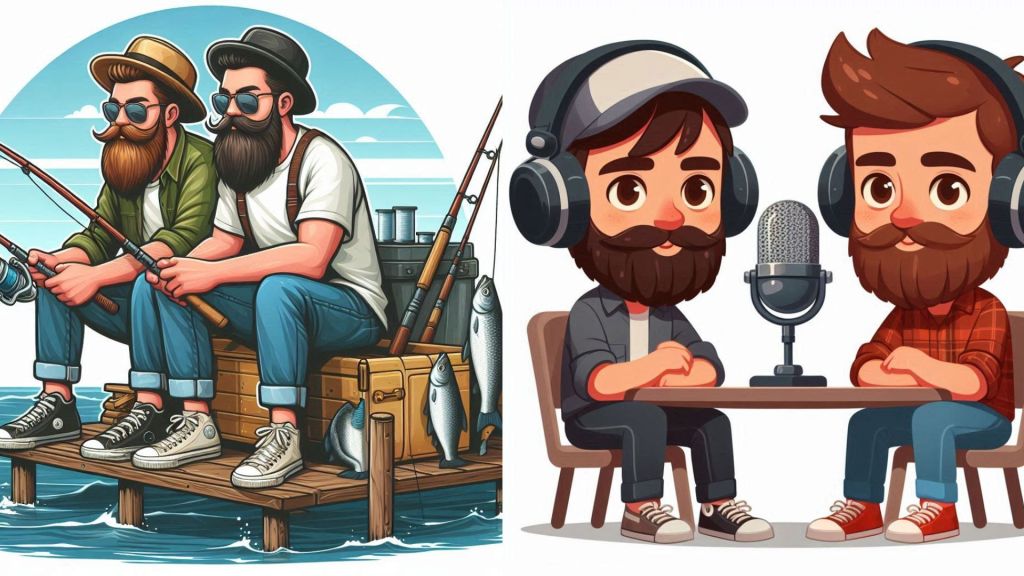
I remember when I was younger, my dad would occasionally decide to get up early on a Sunday morning — and I mean early enough you would be excused to think it was still yesterday — grab his fishing gear and disappear for a day. He’d then come back in the evening, somewhat relaxed, and not always bearing fish. Infrequently, he’d even make a whole weekend out of it — with a tent and everything.
On one or maybe two occasions, my mum would make him take me, which I don’t quite remember with enough detail to say if he enjoyed the idea of adopting a pup for his trip. What I do remember, however, is that every time I went, I just didn’t have a good time. At all. The novelty of setting up a fishing rod, organizing the site, and dealing with hooks and worms would quickly dissipate to make space for good old-fashioned boredom. I’d just sit there looking at the lake, count trees on the other side, throw rocks for exactly three seconds before being told off for scaring off the fish and just mind my own business. Meanwhile, he’d just sit there with his two buddies in complete silence. They would occasionally exchange a few words, but they’d stay mostly silent while fishing. Conversations would flare up during breaks, but overall, these fishing expeditions would look like glorified experiments in meditation with lots of extra steps.
And I never understood the value of leaving the house at the crack of dawn to sit outside, exposed to the elements, occasionally in the rain, while accomplishing a grand total of not much. For a ten-year-old like me, this was an unthinkably unsocial way of spending time together with your best mates.
But I think I get it now.
What fishing was for the generation of my father was an escape from the gruelling reality of a working adult life. What is more, despite what it looked like, it was an incredibly social event because for those guys the idea of sitting together often in complete silence still counted as quality time. Because they would do something together. They all sat there and looked in the same direction. They were engaging in some kind of a ritual. They were on a mission together. And now I think I understand that for middle-aged men back in the day, the idea of heading out with their mates to engage in the procedure of fishing in a lake was tantamount to therapy. The same men who are often accused of not opening up, not talking about their problems, bottling up their frustrations and everything else you’d now find conveniently summarized under the term “toxic masculinity” in the Oxford English Dictionary, would have their own ways of dealing with their many frustrations that didn’t involve speaking to a therapist.
Looking at my own Millennial generation, I can only see that the tradition of going fishing has more or less gone extinct. Perhaps it is partly because our fathers didn’t care all that much about teaching us about the value of therapy through fishing. Maybe it’s because they needed to get away from their parental responsibilities too, just to retain a modicum of sanity. Or maybe it has to do with the fact we have grown up in a digitized world where outdoor activities have been significantly downplayed and supplanted by video games, socializing online and whatever else you fancy that doesn’t necessarily involve going outside, let alone camping.
But that doesn’t mean we somehow evolved in the interim and that we no longer have to address the same needs or combat the same frustrations our fathers did while away fishing and mushroom picking. Young and middle-aged men still have the same pressures. Perhaps our pressures have even been additionally exacerbated by the simple fact we have been living in a state of perpetual global crisis for over two decades now. Therefore, it is only logical to imagine that we have — perhaps inadvertently, organically and without much forethought — engineered solutions to provide a means to escape, socialize and develop that is fit for modern times. And one such solution is podcasting.
“Men will start a podcast before going to see a therapist” has become a recurring meme in the sphere of social media, usually resurrected to underscore a point relating to the difficulty with which many men would allow themselves to be helped… as though to prove we are self-fulfilling prophecies of some description because we won’t let others help us, we won’t talk about our issues and then we’ll turn into human-sized bottles of kombucha ready to explode after a period of uncontrolled fermentation. Nothing could be further from the truth.
At least from where I am sitting, podcasting is a form of therapy that many men my age embraced as an alternative to the more socially acceptable forms of talking therapies. You see, many of us prefer not to talk about our issues… but we still want to talk and engage. And podcasting allows us an opportunity to (1) develop an organic opportunity to get together with friends, (2) to make new friends, which everyone will testify gets progressively harder as you age, (3) talk about stuff you enjoy and (4) wrap this entire process around something you can progress and develop. I, like many other men, like to have a project. A mission. Something I can do that allows me to co-exist with other people but doesn’t require me to focus on verbalizing my emotional states and talking through my problems, which is admittedly incredibly difficult for many of us.
Having started a podcast in January 2021 and having seen it progress very slowly over the course of the last nearly three years I can safely say that podcasting has become to me what fishing used to be to people like my father and his mates. It’s a brief escape from the pressures of my own life, an opportunity to do something constructive together and — indirectly — a platform to tap into my own emotional turmoil if and when I feel I can comfortably share what I’m going through. It is an honestly fascinating outlet to do something many of us either forget how to do or rarely get the opportunity to try — to be in the moment. It’s a platform to cognitively reframe your own emotional wellbeing, work through whatever it is you need to work through and also focus on performing tasks rewarded with a release of oxytocin, which is sometimes described as a job-well-done hormone, among others.
I think this last bit is key here because in contrast to many other activities men would typically gravitate to, like video games, gambling, social media use or even pornography, in search for escape from the crushing vice of their daily existence, all of which reward us with temporary spikes in dopamine and all of which running a serious risk of devolving into a debilitating addiction, podcasting seems to stimulate us differently. Now, I don’t have exact data to hand and what I am trying to articulate is mostly based on a combination of my own experiences and proximal relationships to other similar activities that are constructive and social, so please take this as a personal account as opposed to any form of generalized prescription. From what I have gathered so far and how I have looked holistically at my own journey with podcasting and its influence on my own mental health (combined with anecdotal experiences from other people claiming to have found similar satisfaction in this regard), I can only recommend it to anyone who thinks talking to a therapist is a complete non-starter, and who would scoff at the idea of going fishing either.
In fact, it’s way more sustainable than fishing or any other outdoor activity that requires a much higher activation energy to get started. You don’t have to make specific life adjustments, acquire expensive gear or find a suitable spot. All you need is a microphone and a device like a laptop, a tablet or even a phone. The rest will take care of itself because as you develop your initial idea, you will invariably begin making the right kinds of moves. You will make plans. You will outline. You will schedule. You will prepare. You will make time to sit down and actually record. All these things will add up to a process that is way more important than obtaining a finished product, let alone having this product released for public consumption. All that matters is that you do it.
The act of fishing is more important than bringing some fish home for dinner. In fact, many fishermen release their catch immediately, so you will be excused if you choose to keep your recordings private. But it’s way more fun if you let others listen to what you have to say, and it will provide additional stimulation to keep you motivated and disciplined to come back to record some more. Which is another key feature of podcasting as a form of self-care — the notion of it becoming a ritual and a self-propelled social engagement that will bring you together with people you enjoy being with to sit down and build something together.
Between the idea of being in the moment with other people, embarking on a shared mission, seeing a sense of progression and — most importantly — a feeling of doing something constructive, podcasting is a nearly perfect outlet for holistic self-care, and I cannot recommend it enough to anyone who ever asks me for a piece of advice on mental wellbeing. Crucially though, I think it is a godsend for men my age who may frequently feel either woefully unqualified to externalize their emotional states, or who may feel they are rarely heard, seen, or understood.
Get a microphone and speak into it. Someone will eventually find it, listen and enjoy your worldview. Someone else will maybe find you and choose to speak with you too. It’s only a matter of time. That’s how I met my great buddy Randy who one day found my podcast, listened and now we host it together. It’s a small venture, but it doesn’t matter because the ritual is what counts.
If you sit on a pier with a fishing rod for long enough, you will catch something eventually. Someone might sit by your side and after a while, you will develop kinship with them. Just by virtue of sitting on the same pier and looking the same direction. Doing so made men like my father recharge and renew. Podcasting is doing the same for me. And it might be right for you, too.
This article was originally published on Medium.com on 14th December 2023.


 Flasz On Film
Leave a comment