It all started with a man getting out of an Uber, refusing to pay and then proceeding to unleash unspeakable carnage at a Taylor Swift-themed dance class for little girls. He murdered three innocent children and wounded many more. I shan’t mention his name. I have my reasons.
What followed were days of rioting and civil unrest the UK has not seen since the summer of 2011, because someone somewhere in the unregulated Wild West of the Internet spread the rumour suggesting the perpetrator of the calamity at a dance class was an illegal migrant. The racists were mobilized and decidedly ready to—as they see it—“take their country back.” Violence ensued. Further rumours spread. The new incumbent government buckled temporarily as their honeymoon period in power ostensibly got put on hold. The public was taken aback. Fingers pointed at social media, toxic influencers (you know who they are), opportunistic snake oil-selling politicians (you know who they are as well) and careless media moguls. This whiplash of public disorder and violence came out of nowhere and T-boned the dazed British public life.
Only it didn’t. The days of hate-fuelled violence aimed at some of the most vulnerable people in our society—asylum-seekers and immigrants—did not come out of nowhere, just as a pickup truck materializing out of your blind spot to smash into the side of your car doesn’t just teleport into this position either. Someone put their shoes on, got into that truck, pulled out of their driveway and at one point decided to run that red light while you were crossing the junction in the perceived immunity granted by the green colour projected towards you. Violence organized this well and targeted this precisely at people who had absolutely nothing to do with the event which allegedly sparked it never just happens, just as Kristallnacht in 1938 didn’t just happen either. Some people out there in the world had spent way more time than you might imagine thinking about it, scheming, planning and waiting for the moment to pounce and we just let it happen. Collective complacency at work.
Look, those who don’t learn from history are doomed to repeat it—the adage goes. It’s a good one to remember because it sends a powerful message. But it’s not exactly reflective of reality either. History doesn’t repeat. It rhymes. Therefore, anyone wishing to see themselves as an evolved human being attuned to the world at large and trying to identify the trajectory our culture is following needs to adjust the parameters of their observations and proactively look for how our predicament might rhyme with the past as opposed to how it might repeat it. Admittedly, this task is much more difficult as it requires us to do more than just map the past onto the present and look for the next Hitler to arise or for the next Holodomor to take place. Chances are, neither of these things will happen, but I can reliably bet a considerable sum of money on a possibility that future historians will be able to connect the dots between where we are now and the decade which led to the outbreak of World War II by way of finding a rhyming pattern between these two periods.
However, we don’t necessarily need to wait a century to see them and we are not entirely powerless, although it often feels as though we were only mere grains of wheat trapped between the millstones of history, slowly ground to dust by incomprehensibly powerful forces. We can see where we’re going and perhaps we are able to adjust our collective trajectory.
Therefore, instead of looking for the next Hitler and wondering which conservative politician is the likeliest of the lot to turn the UK into an authoritarian ethno-state, we might want to figure out how our cultural temperature reflects any of the various moods of the past. You might want to read Berlin Alexanderplatz or Arc de Triomphe to peek into the era we fear our times might rhyme with. By all means, do. Your lives will be enriched for it because these works are phenomenal in their own right. You might want to watch Michael Haneke’s The White Ribbon to gain some more understanding of the mechanisms operating under the epidermis of a society sliding towards fascism.
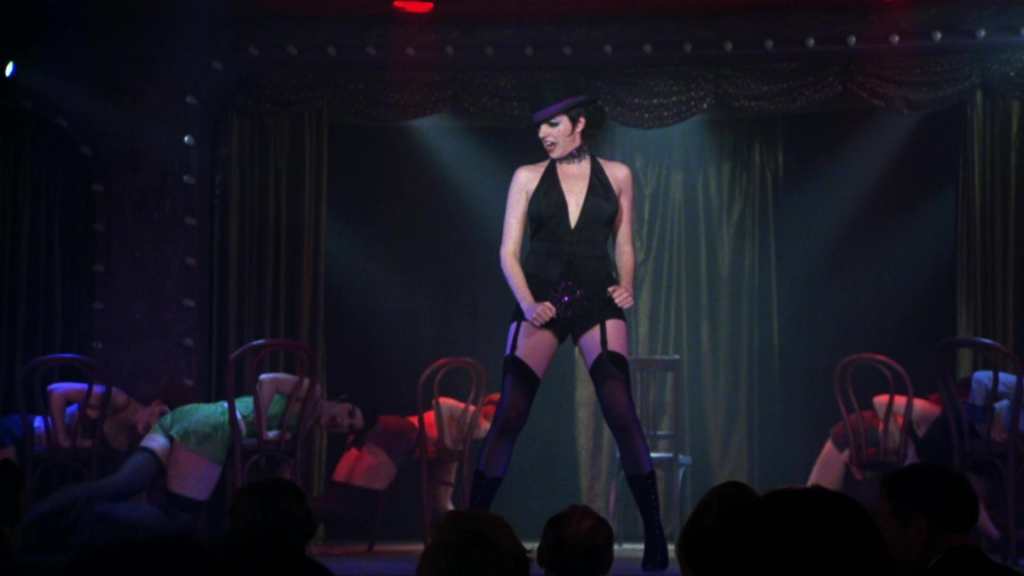
However, today I’d like you to go up to your DVD shelf or nip out to the library if you don’t have it handy, and watch Bob Fosse’s Cabaret. Although it was released in 1972, I think it is particularly pertinent to where we are now and how “the present times we live in” rhymes with the past, perhaps because the stage musical it was based on traces back to a play (the 1951 I Am a Camera by John van Druten) which in turn was based on a novel from minutes before World War II broke out in Europe (the 1939 Goodbye to Berlin by Christopher Isherwood). This de facto anti-musical is perfectly capable of focusing an analytically-inclined mind on its form, how Fosse’s camera reinvented the genre and how its cultural footprint became inextricably linked to some iconic songs performed by Liza Minnelli. But I’d like you to look beyond the obvious and past the artifice of a New Hollywood musical reframing a stale genre into a singular entity forever to be enshrined in the annals of the medium as one of the most important works of its kind.
When you look past the steamy sheen and Fosse’s phenomenally refreshing approach to the genre he was moulding anew, you will see Cabaret as the swan song to decades of excess and—crucially—a bit-for-bit anatomical study of a society destroying itself like that proverbial frog experimentally put in a pot of water slowly brought to a simmer. It doesn’t even require all that much attention to notice how the movie wrestles with the notion of young career-obsessed hedonics dancing and singing and partying and boozing and schmoozing while the country is changing around them.
What you might not notice unless you understand a lick of German is that in between bouts of musical pageantry and romantic to-and-fros between Sally (Minnelli) and Brian (Michael York) we frequently hear radio announcers talk about the news. We see headlines in newspapers people read. And what the news is should send a shiver down your spine because you know where it leads. The hatred, the “othering” of minorities, the stages of a genocide in progress outlined on live air. They’re all there in the media which people consume. Consume and internalize. Internalize and—soon enough—accept as parts of the reality they live in. Tell them a lie a thousand times and they’ll take it as gospel. Point a finger at a group of people and pin your woes onto them and you will turn them into an enemy. Extermination by category will follow from there with tacit acknowledgment from some and rabid endorsement from others. Meanwhile, those smart enough to oppose it will cower in fear, look the other way or flee.
Fosse also shows us, at first infrequently, tableau images of extreme violence Sally and Robert often drive past on their way to and from wherever the hell they spend their sweet time. And even though Robert seems “culturally switched on” and capable of identifying what’s on offer and how the country is changing, they are almost always sequestered from it. They are safe behind the window of a car, zooming past crime scenes and sparing merely a glimpse. If they had social media, maybe they’d share their thoughts and prayers hoping for likes and other forms of online kudos. They offer looks of support for their Jewish friends, bundled together with vocal expressions of understanding and empathy. But they do not feel the need to do anything because—push comes to shove—it’s none of their concern. The country is slowly sliding towards a state-sanctioned genocide and they don’t care because what they see happens effectively in a different world and the news communicated to them is delivered in a language they might not necessarily understand. They are too preoccupied with their romantic exploits. Sally is busy dancing and building her career and Robert is all wind and no trousers as he claims to understand what’s happening but chooses not to engage with the culture he so vehemently despises.
Why bother? He’s but a cog in the machine. But a grain of wheat trapped in a fascist millstone. Ground to powder. And after all, it all seems insignificant and tucked away into some kind of abstraction when you’re in a taxi. These scenes of violence seem fake and totally staged when witnessed from that vantage point. Equally, when Sally performs on stage every night, the stage lights prevent her from seeing the gradual change in the audience attending her acts. In fact, Fosse deliberately obscures this view as well, but it’s undeniable. Even out of focus and shape you cannot mistake the diarrhoea-brown uniforms and the red armbands slowly replacing suits and evening gowns. What is even more frightening is that the audience is not replaced by other people who happen to be openly fascist. Maybe to an extent, because some people perhaps would have chosen to flee the country, anticipating the worst. But what may be at play—and the filmmaker points to this possibility too—is that the people who used to wear suits and gowns to see Sally sing and dance now wear brown and red because they feel safe in expressing their views publicly. The swastika branding is socially acceptable enough because the critical mass has been reached.
To make this assessment irrefutable, the film brings Sally and Robert up close to the regular folk and shows us who these people are. They attend what looks like a fair where the crowd spontaneously erupts into a fervent song “Tomorrow Belongs to Me.” I would argue this is the most memorable song number in the film, not the one about money or anything else delivered from the stage of the titular cabaret. This song illuminates something stark, tragic and bone-chilling. The slide towards authoritarianism and impending genocide is enabled and supported by the public who allowed their brains to be washed with propaganda. By regular people, some of whom you may know, work with or dine with.
While upper-class Berliners danced and sang and drank and gallivanted, the regular folk festered with hatred pumped into their eyes and ears by powers-that-be and their enablers. The today equivalent of those Weimar Berliners would numb their brains on TikTok and Instagram, laughing at memes and arguing about bathroom rights of people they’ve never met. Meanwhile, their personalized social media algorithms would deny them the knowledge of a myriad conspiracy theories festering in places they don’t even know exist. Today’s dancing Berliners may have heard of The Great Replacement Theory, QAnon, Two-Tier Policing and other ideas propagated in the far corners of the Internet. And they all dismiss them as inconsequential, harmless and dumb. They see those who subscribe to them as indistinguishable from Flat-Earthers. They pity them and move on to stage their new TikTok dance because maybe today they will hit it big, go viral and get the kudos they so desperately crave.
Meanwhile, the public who take their news from the Daily Mail, the Express and their Farage-supporting uncle are busy singing—with pride and conviction—that tomorrow, after all, belongs to them. Thus, the historical rhyming pattern connecting our times to the reality of the Weimar Republic in its dying days has little to do with the rise of “the next Hitler” but with the way we collectively dismiss the anger and hatred compounded by the years of austerity, finger-pointing and “othering” of immigrants because we have been persuaded to see those who subscribe to such views as merely an inconvenience and a small cohort of terminally gullible people.
What I find ironic is that the universe has seemingly been trying to tell us about it for a while now. When the government in Myanmar was taken down in a violent coup d’etat a few years back, one of the lasting images of this political upheaval involved a young girl filming herself dance—presumably for an online class, but maybe for a TikTok—while ominous-looking black SUVs pulled up behind her, stopped in front of what I believe was a governmental facility and spilled armed men who began their purge. The universe showed us an image of a woman dancing while the country was crumbling to pieces, the exact image Bob Fosse’s Cabaret painted in 1972. And we made memes about it. We laughed and laughed and laughed.
The recent events in the UK show clearly we must not be complacent and allow racist thugs to take over the country. They are not harmless. They are not inconsequential. They are prepared, ready and fuelled by what they see as a just cause. They won’t stop unless they are met with equal, opposing reaction. This time, the British public passed this test as I saw throngs of regular people take to the streets and shoo the racists off in a collective display of values of fraternity and compassion.
But make no mistake, the history has rhymed. “Tomorrow Belongs to Me” is being sung somewhere right now and it is up to us to confront the evil before it is allowed to take over. And if you feel powerless and inconsequential in this battle, worry not. If you confront your uncle at the dinner table about his racist views, you’re doing your part already.


 Flasz On Film
Leave a comment