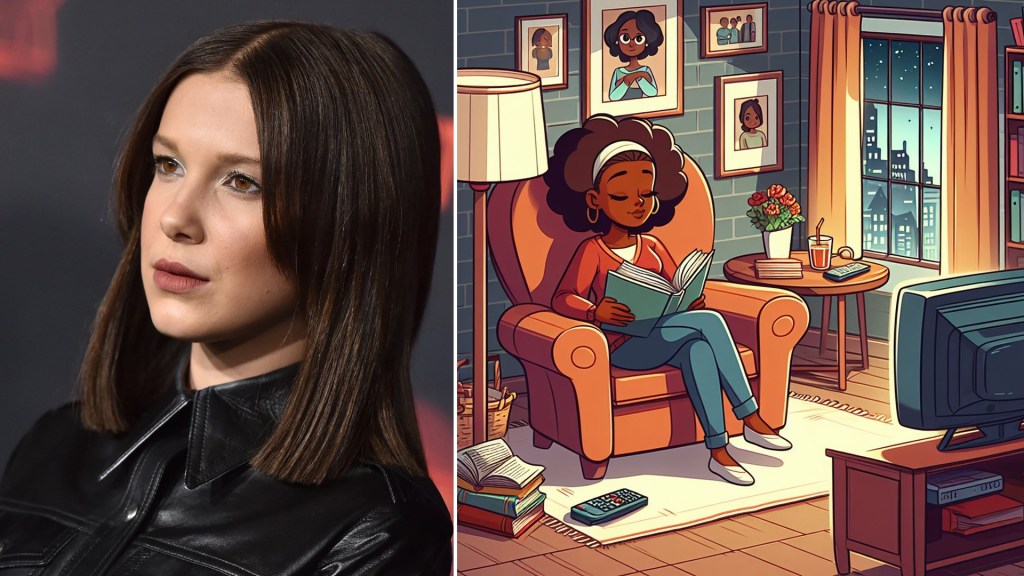
Millie Bobby Brown landed herself in hot water recently after admitting she doesn’t like watching movies. I believe the exact “offending” quote is as follows:
“I don’t watch movies. People come up to me and say, ‘You should definitely watch this movie, it would change your life.’ And I’m like, ‘How long do I have to sit there for?’ Because my brain and I don’t even like sitting for my movies.”
She then went on to say:
“My fiancé is the biggest movie buff. He just sits and watches movies all day. And I cannot do that. That is the one thing I can’t sit down and do. But I really like Lara Croft in Tomb Raider, I love Mad Max. So, I feel like I’m always channeling that inner bad-ass.”
Now, I’m not here to psychoanalyze Millie Bobby Brown or to deconstruct that statement in defence of the way she chooses to spend her time. Nor do I feel it is my place to comment on the seriousness with which some corners of the movie fandom have responded to this apparently radical statement I’m pretty sure she viewed as a throwaway opinion. Maybe it is a reflection of what happens when parents push their kids into careers they may not necessarily have an organic passion for. I don’t know and – again – it’s not my place to opine. What interests me more is whether an actor needs to watch movies to be an actor, or more generally speaking, do I need to passively ingest X to be good at actively producing X?
Whether you like films and TV shows Millie Bobby Brown starred in is beside the point here. We’d be here all day if we allowed this conversation to descend into an argument from taste where “I think I’m right because I don’t like Godzilla vs Kong or Enola Holmes” was deemed pertinent to the point you’re trying to make. Whether the movies she’s in are any good is honestly irrelevant and it equally doesn’t matter if she’s the modern equivalent of Meryl Streep either. What matters is the simple fact she is a competent professional capable of playing a character, delivering lines and internalizing aspects of the role audiences would respond to. She is clearly capable of doing the job of an actor despite the fact she’s not a fan of watching movies. Which means you probably don’t have to watch movies to be good at acting in them.
The conversation would likely be different if we extended it to film direction or screenwriting because there are certain aspects of the form you simply need to be familiar with to put a screenplay or an entire movie together. However, I think you’d still be surprised at just how few movies your favourite filmmakers watch. Ask Christopher Nolan how many films he watched last year and you’ll probably hear that he doesn’t do all that much film-watching. Because it is after all quite a time-consuming pastime. I bet you money that William Friedkin, Alfred Hitchcock, Fritz Lang or Akira Kurosawa watched way fewer movies than you do.
I’m reasonably certain Werner Herzog barely watches anything and he is still one of the most important living filmmakers full-stop. In fact, if you ask him what an aspiring filmmaker should do to get better at the filmmaking craft, Herzog will never send you away with a list of movies to watch. He’ll tell you to read. Read, read, read, read, and read some more. He’s actually quite famous for it.
Still, some filmmakers do watch a lot of movies and in fact it shows. Martin Scorsese, Paul Schrader, Quentin Tarantino, Steven Soderbergh, Robert Rodriguez and others are known for being voracious film-watchers with high film IQ, and their work reflects this passion. Their movies are replete with film references, nods and winks to the viewer. Broadly speaking, they are as successful as they are partly because of the many ingenious ways they managed to fold their movie-watching passion into their work and weave their own active filmmaking around their passion for passively ingesting the filmmaking output of others.
So, you could perhaps conclude it is in your best interest to ingest X to become good at actively doing X. Which would be a big mistake because – again, I bet you money – if you asked Tarantino, Scorsese or Schrader what they do in their spare time, you’d find they read a lot. They go out to see stage plays. they are fond of going to museums. They do other things, too. Therefore, the prescription I would devise having thought about it for a little while is that to become a good filmmaker you don’t need to watch movies. But it helps. What you need to do is make movies. To be a good actor, you don’t need to watch other people act. You just need to practice your craft. Still, watching other people act will likely help you develop your craft further. But watching passively will never get you there. Nobody ever got good at dancing after exclusively watching other people dance a lot.
In fact, I’d go a step further, but to do that I have to make a personal confession. I hardly read any film criticism. I find movie reviews boring as hell. Now, I don’t particularly like the label of a “film critic” as I find it self-aggrandizing and pompous, but I guess by virtue of engaging in the act of writing about film and culture – insofar as barely anybody reads what I write anyway – I might be considered one. Still, I actively avoid reading film reviews and I see Millie Bobby Brown’s statement regarding her acting vis-à-vis movie-watching as personally empowering. And that’s because I strongly believe that not only won’t reading lots of movie reviews help you become a better film writer, if all you do is watch movies and read other people’s film criticism, you will actively limit yourself as a writer. What you will end up producing is an increasingly self-regurgitated work with progressively diminishing originality.
Therefore, I choose to read anything but film criticism. In fact, I have found in my travels that my craft and ideation with regard to writing analytical work have consistently improved whenever I read almost exclusively fiction. Novels. Short stories. I don’t think Pauline Kael and Roger Ebert consumed volumes of work on cinema. Something tells me they read loads of novels.
Why? I don’t know; my suspicion is that on top of increasing my vocabulary – for which reading literally anything is a good prescription – interacting with fiction develops my non-fiction writing acumen because it turns what otherwise could be a purely formal exercise in adjective-stacking into an exercise in storytelling. As I said, I actively hate reading film reviews because 99% of them do not have anything interesting to say apart from describing what the author felt about the movie they watched. Boring. Tell me something interesting, find an angle.
I wrote about this problem years ago and today it has become more relevant than ever because we are now living in an age where ChatGPT can supplant an uninspired review after prompting it with a set of bullet points. Content journalism is on its deathbed, and it is exactly because writers don’t read and what they do read is what they write. So, recursively, iteratively, consistently they are blunting the edge of their own voice so much that a Large Language Model can manufacture output indistinguishable from theirs; exactly as formulaic and uninspired.
Therefore, I can only lament the fact the movie community online has responded so viscerally to comments I find not only innocuous but perhaps carrying an invitation to expand your horizons. To be a practitioner of X (acting, directing, writing), you don’t necessarily need to ingest X. It helps, but it equally comes with the risk of setting a ceiling on what you can possibly accomplish. If all you read are film reviews, you will write film reviews like the ones you read. If all you listen to is death metal, your own death metal will probably not be very original. If all you do is watch other people act in movies, it will set a ceiling on how you will act in the movies you’re in. So, in a way, the Millie Bobby Brown school of “I don’t have time for movies” is not an indication of how limited her craft is. It might be the opposite because she might read a lot. Or she finds inspiration elsewhere. You know – in real life. But I don’t know if anyone cared to ask her because they had already got the soundbite they needed to boost online engagement, generate clicks and bring some eyeballs in front of more formulaic and uninspired listicles their websites are teeming with.
Meanwhile, I take it as validation of my own process. So, there. Read, touch grass. Read some more. Engaging with stuff that isn’t the stuff you do can only help you develop your craft and make your voice a tiny bit more interesting. At least that’s what I think.


 Flasz On Film
Leave a comment