I don’t think I planned for this piece to come together this way – in fact, I wasn’t planning to write it at all – but I believe it’s appropriate to begin with a few words on the why of it all. Why, oh why would anyone decide to write anything about a Stuart Gordon movie that I’m not even sure Stuart Gordon remembers directing?
Well, if you know anything about me, you’d probably think it’s enough of a reason in its own right because I love talking about movies literally nobody else cares about, let alone likes. However, in this particular case of a little movie titled Robot Jox, I have a strong personal connection to it and as of now I am also working on at least one more essay connecting somehow both to my personal past and to this movie as well. So that’s your reason. We’re not celebrating any round anniversary of this movie’s release. This isn’t a chapter in a Stuart Gordon retrospective. I just felt like writing about Robot Jox. So here I am.
Robot Jox came out in 1990, directed by Stuart Gordon and written by Joe Haldeman (whose screenplay was based on Stuart Gordon’s story idea). Well, technically it was made in 1989, just a few short years after Dolls, but its release got delayed for almost a year. It doesn’t matter. The movie came out and bombed mercilessly to the accompaniment of truly scathing reviews. Nobody liked this movie, and nobody even cared it was there.
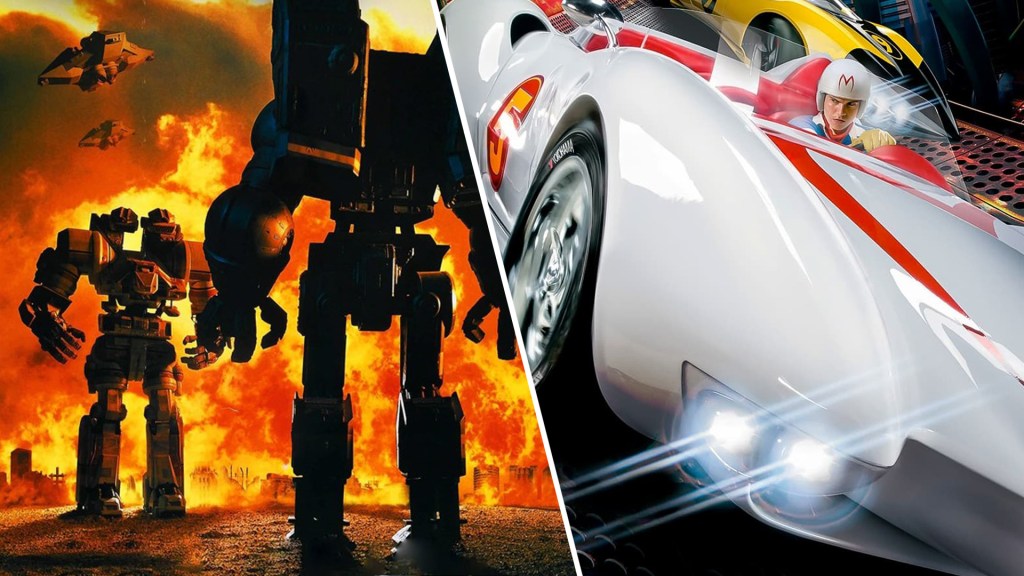
Well, I cared. In fact, it may have been one of the first films I ever saw and definitely it was one of the first VHS tapes I ever brought home to personally push into the family VCR, even though I was probably way too young to be watching it to begin with. However, I somehow managed to convince my dad to let me rent it because – being very much into Transformers and Tosho Daimos (more on the latter in not-too-distant future), I felt the cover sporting two massive robots duking it out against the backdrop of roaring flames was speaking to me on a subliminal level. It sang like a siren.
I don’t remember much from that first viewing experience, perhaps apart from what turned out to be a part of the opening of the film where a massive robot squashes a pilot of another massive robot like a bug. Everything else about the plot – from the big picture elements of post-apocalyptic politics that somehow rationalize the idea of massive robots fighting for ownership of countries, to laboratory-grown pilots, spy intrigues and people wearing cowboy hats indoors – completely evaporated from my memory, so you can imagine my surprise when I sat down to rewatch Robot Jox (having purchased a beautiful boxset from Arrow just to have that opportunity) and realized the movie wasn’t good at all. It almost makes sense to me retrospectively that I was allowed to watch it as an eight-year-old, because I can only assume that whoever sat down to watch it with me (and I think it might have been my father) either checked out or fell asleep after the first five minutes. Because – understandably – Robot Jox is terminally braindead.
But I loved it as a kid. I swallowed hook, line and sinker its stop-motion shenanigans. I didn’t mind its utterly contrived plotting. I didn’t care one iota about its lo-fi production design that makes Battle Beyond the Stars look like The Planet of the Apes in comparison. I was hooked because I loved massive robots and Robot Jox was by far the first live action movie (or at least the first one I am aware of) that dealt with this concept. In fact, it was supposedly designed to function like a live-action cartoon and Stuart Gordon insisted it would play well with younger audiences… and then he proceeded to fill this movie with scenes you wouldn’t want young kids to see, such as Verhoeven-esque co-ed bathrooms (sandwiched betwixt Robocop and Starship Troopers, mind you) and a few instances of graphic violence that could and should give any ten-year-old nightmares for at least a little while.
Although it was an adaptation of a cartoon that never existed and it was probably mostly inspired by Transformers cartoons and other productions such as Voltron, not to mention anime like The Robot Romance Trilogy (of which Tosho Daimos was the third part), Robot Jox wasn’t made with children in mind. It was produced to tap into a nostalgia groove of those barely adult audiences who just a few years earlier watched Transformers: The Movie and Voltron after school. Problem is, those audiences were probably still young enough to unabashedly indulge in re-watching their favourite cartoons and brandished Transformers toys in their university dorm rooms, because there’s no shame in liking that kind of stuff and they probably knew that.
Which is why Robot Jox didn’t connect with anyone. In doing so, it blazed the trail for another similar – yet definitely better produced and more polished – product that saw the light of day almost twenty years later, the 2008 Speed Racer directed by the Wachowskis. It also failed to connect with general audiences (and I am on record for not being its biggest fan either), presumably on the back of a symmetrical issue. It was an adaptation of a cartoon contemporary kids had no business liking and it was too mature for them to connect with it anyway. Speed Racer was made for people who grew up watching the cartoon at the time and who would have been primed to like it powered by their nostalgia for the original. Unfortunately, the era of nostalgia was just beginning, and audiences weren’t quite ready to embrace this kind of earnest storytelling awash in camp.
They would have been in 2013 when Pacific Rim saw the light of day and it would have been the perfect opportunity for Robot Jox to be rediscovered and for a cult following surrounding this little genre oddity to gain enough prominence to become culturally sustainable. Problem was that nobody liked Robot Jox in 1990. Apart from me. I L-O-V-E-loved Pacific Rim (and in fact, watch this space because more words on that are coming here soon) and cherished the idea that some people might look back upon Robot Jox and give it its day in court.
Which they did. And they… just moved on.
You see, the problem is that Robot Jox is not a good movie. In fact, it’s pretty bad and it is probably only possible to like it if you have a strong personal connection to it like I do. So, I cannot honestly recommend it to anyone because whoever ends up buying it and watching it on my recommendation will hate my guts. It’s a bad B-movie. But it’s a bad B-movie that somehow forms a part of the blueprint of why I love movies because it feels magical and audacious, and it swings for the fences despite having absolutely no resource or skill to follow through on its ambitions. It’s a movie that makes Roger Corman films look professional in comparison.
But it is equally an important piece in the evolution of the genre – a lynchpin connecting 80s cartoons and 70s anime to the world where Michael Bay’s Transformers movies exist together with Pacific Rim, the Hollywood incarnation of the MonsterVerse, and even the Toho legacy embodied by the most recent (and amazing) Godzilla Minus One. It might be a hard sell but somewhere between the world of Hollywood-derived spectacle courtesy of Gareth Edwards and Michael Bay and the motherland of Kaiju and Mecha in the Land of Cherry Blossom lies a missing link – a terribly made Stuart Gordon movie that brought the sensibilities of the East to Western audiences in a way that was completely unpalatable to anyone at the time.
Robot Jox was a movie doomed to fail. And as provocative as it may be to some – specifically those who hold the Wachowskis in extremely high regard – its fate I see as symmetrical to the one shared by Speed Racer. It was too childish for adults and too mature for kids. And completely incomprehensible to critics who simply had no idea how to contextualize its existence. And they couldn’t recommend it to anyone.
Yet here I am. Against my better judgment I am telling you to seek out Stuart Gordon’s Robot Jox and give it a chance. It’s not a good film. But if you like Transformers, Pacific Rim, anime and camp, you might find what I see in this pile of schlock – a deeply caricatured attempt at doing something the world has since learned how to do much better, which is turning cartoons into watchable live-action affairs.
Robot Jox died so that Speed Racer would have a fighting chance to flicker and over time build a cult following it has now. It failed so that others could try harder. It made mistakes so that others wouldn’t have to repeat them. And for that I salute Stuart Gordon and his rag-tag crew who brought big robots to the screen at the time Michael Bay was falling in love with John Woo and Tony Scott and was yet to burst onto the scene with Bad Boys or The Rock.

 Flasz On Film
Leave a comment